

Bruce Smyth discusses his work at a national research agency. He considers the divide between academic and applied sociologies in the context of his recent move back to university work.
By Bruce Smyth [1]
Until recently, I worked at the Australian Institute of Family Studies (AIFS) as a researcher in the area of family law and post-separation parenting. I am now at the Australian National University (ANU) building a research program around family law issues. While both workplaces have very different cultures with respect to collegiality, intellectual property, and bureaucratic process, the reality is that not much has changed. In essence, I continue to work as an applied sociologist conducting specific ‘problem-focused’ research directed at pressing policy problems (e.g. Why after divorce do one in four children in Australia have little or no cont act with their father?)
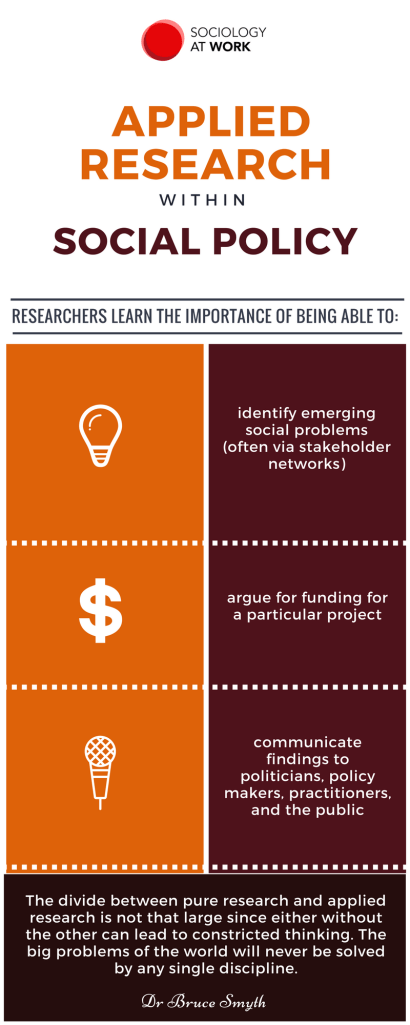
At AIFS, only applied research with a hard policy-edge is conducted. This means that researchers quickly learn the importance of being able to
- (a) identify emerging social problems (often via stakeholder networks),
- (b) argue for funding for a particular project, and
- ( c) communicate findings to politicians, policy makers, practitioners, and the public.
In this context, there is often not much room for theorising, theory-building or theory-testing. Should some theory turn up during the research process, of course, it can be incredibly helpful in shaping the design of a study, the questions asked, the analytic frames, and the interpretation of findings (especially unexpected ones!).
For me, the divide between pure research and applied research is not that large since either without the other can lead to constricted thinking. The big problems of the world will never be solved by any single discipline. This surely holds true within disciplines too in relation to the pure–applied divide.
My sense from moving to the ANU is that universities are changing. While pure research and abstract thinking are still highly valued, there is increasing interest in attracting applied researchers who can work with government on important policy problems. While my own research rarely produces obvious solutions or answers, it does chip away at our understanding of particular social phenomenon. Hopefully, it also changes people’s lives.
Biography
At the time of first publication (2008):
Dr Bruce Smyth, PhD, is Associate Professor at the Australian Demographic and Social Research Institute, Australian National University, Canberra Australian Capital Territory.
Editorial Credits

Article copyright: © Bruce Smyth 2012. Published by Sociology At Work. All rights reserved.
Working Notes ISSN: 1838-5214
Article citation: Smyth, B. (2012) ‘Changing Places’ Working Notes, Issue 3, October, online resource: http://www.sociologyatwork.org/changing-places/
This paper was originally published in 2008, in Nexus, June 20(2): 9-10.
Discover more from Sociology at Work
Subscribe to get the latest posts sent to your email.
 Sociology at Work