
This is the third instalment in our Careers in Applied Sociology series. The first post discussed the issues sociology graduates experience in finding applied work. The second post gave tips on how to look for work. Today we look at how to write CVs and resumes.
What recruiters look for
Academic examples are not a useful model for most applied sociology jobs (e.g. placing publications near the front). Creating a targeted CV that’s tailored to specific jobs will help you get ahead of the pile!
First, understand how recruiters review CVs and resumes. Many workplaces out-source the long-listing process (refining the list of candidates who will be considered), using automated software, external recruitment agencies, or their Human Resources departments. At this stage, recruiters aim to reduce the number of applications that are sent to the recruitment panel for review. Follow instructions, including number of pages, and tailor the CV to cover the key skills in the job ad, otherwise you may be automatically rejected.
Most recruiters will only scan the first two pages. To get through to short-listing, ensure to addresses the key selection criteria at the start of your CV.
Get your CV professionally proof-read. Free services are offered via your university graduate school, your local council, or employment agency.

The following guide is for recent graduates and early career researchers making the jump to the applied sociology workforce.
Tip: Recruiters will spend only seconds glancing over your CV. Include the key selection criteria that are listed in the job advertisement in your CV as headings and keywords.
Writing your CV

Curriculum Vitae, or ‘CV’ (meaning ‘course of life’ in Latin), is a longer, detailed document of your work and educational history as well as other qualifications and experience. It will include achievements, volunteering and other relevant employment history.
- Keep a ‘master’ copy of your CV that lists everything you’ve done. Use key skills as headings, so you can copy and adapt for specific jobs. Review and update every six months
- List jobs chronologically, using relevant headings to group your work experience and related skills. E.g. Research, technical skills, leadership
- Include the last ten years of experience in your CV. Remove earlier details as you progress in your career
- Follow instructions. Most jobs will specify a page limit for CVs, usually two to five pages maximum

Early in my career, I included my customer service roles. The first job I got outside academia, one year after finishing my PhD, was as a research policy officer in a government agency. The recruitment panel positively discussed my service industry jobs, because I demonstrated how my supervision and management experience translated to the job that I applied for (e.g. Working as a supervisor in a supermarket, I was in charge of budgeting, managing team members, conflict resolution).
What to include

The first page of your CV should have your name, contact details and employment history. For each job, include a couple of sentences. E.g. List your employer, your job title, your start and end dates in the job, your duties, and career highlights. E.g. Did you win an award? Did you help write a key report? Did you assist in a grant?
List jobs in chronological order, from most recent to past jobs, including your skills relevant to the position.
Use clear headings. Short sentences will make your CV easy to scan. For example:
- Research skills: interviewing, literature reviews, statistics, report writing;
- Administrative and technical skills: proficient in Word, advanced in PowerPoint;
- Communication: delivered two conference papers about X & Y; blogger on social policy issues at ABC.com;
- Teamwork: contributed data analysis using Excel on project about community development.
Put an abridged list of your publications at the end. Choose articles that cover themes relevant to the job to which you’re applying.
Do not include protected details, such as your race, religion, gender, age, and do not include your photo, as it may create bias. It is illegal for employers to ask about your personal details during job applications and interviews in Australia and in other countries. The only exceptions are jobs where you are applying under ‘special measure’ provisions, such as jobs that prioritise women under the the Equal Opportunity Act 2010.
Example CV
See below for an example CV from my early career, one year after completing my PhD. My jobs included lecturing, research assistant experience, and customer service jobs.


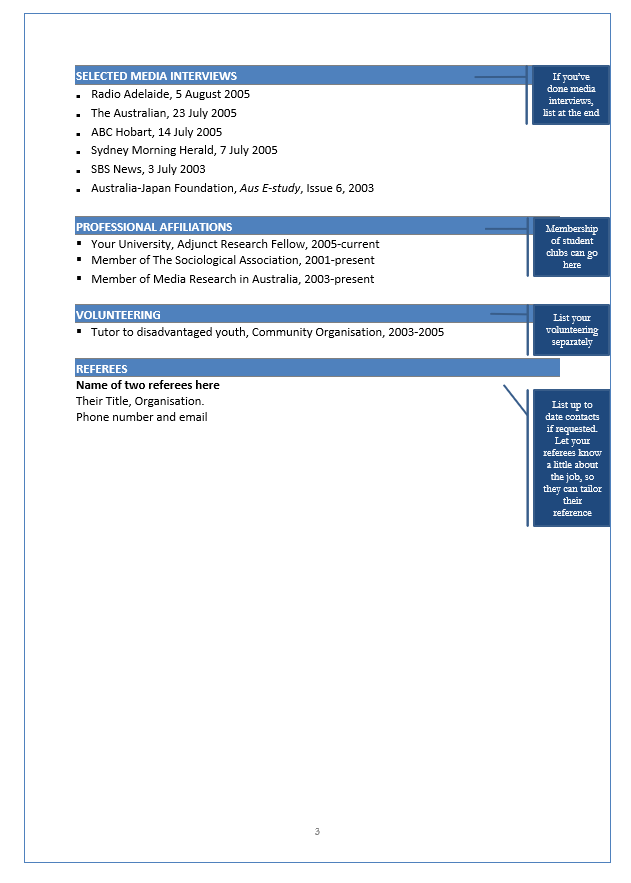
You can download a PDF version of this sample CV here.*
Writing your resume

A resume is a conscise summary, one-to-two pages, highlighting your career and achievements, with examples relevant to the specific job to which you’re applying.
- Create a custom resume to fit the job, using headings that mirror the job advertisement
- Use bullet points, headings and bold text to show how you are qualified for the role.
- For social research or marketing companies: focus on the research methods you’ve used. E.g. Use headings such as ‘qualitative research,’ ‘focus groups’
- For policy or not-for-profits: focus on the projects you’ve undertaken using plain language. E.g. ‘My third-year research project analysed income inequality among vulnerable communities.’
Sample resume

You can download a PDF version of this sample resume here. *
Looking after yourself

Looking for a job is often the equivalent of a part-time job, in terms of the time and skills you will need to invest.
If you don’t hear a call back after a couple of weeks from when you applied, consider calling the recruiter to ask for feedback. This has been one of the best ways I’ve improved my CV and applications over the years, as I moved to different industries.

Make the time to stay positive and to look after your wellbeing. Set goals and rewards to stay motivated. For example, you might aim for one long application per week (applications requiring statements against selection criteria), plus two to three shorter applications (those requiring only a cover letter). Do something to clear your head, even if it’s just going for a walk every day.
Next time we cover job applications!
Notes
*This post was updated on 24 January 2025 with new CV and resume samples.
Discover more from Sociology at Work
Subscribe to get the latest posts sent to your email.
 Sociology at Work