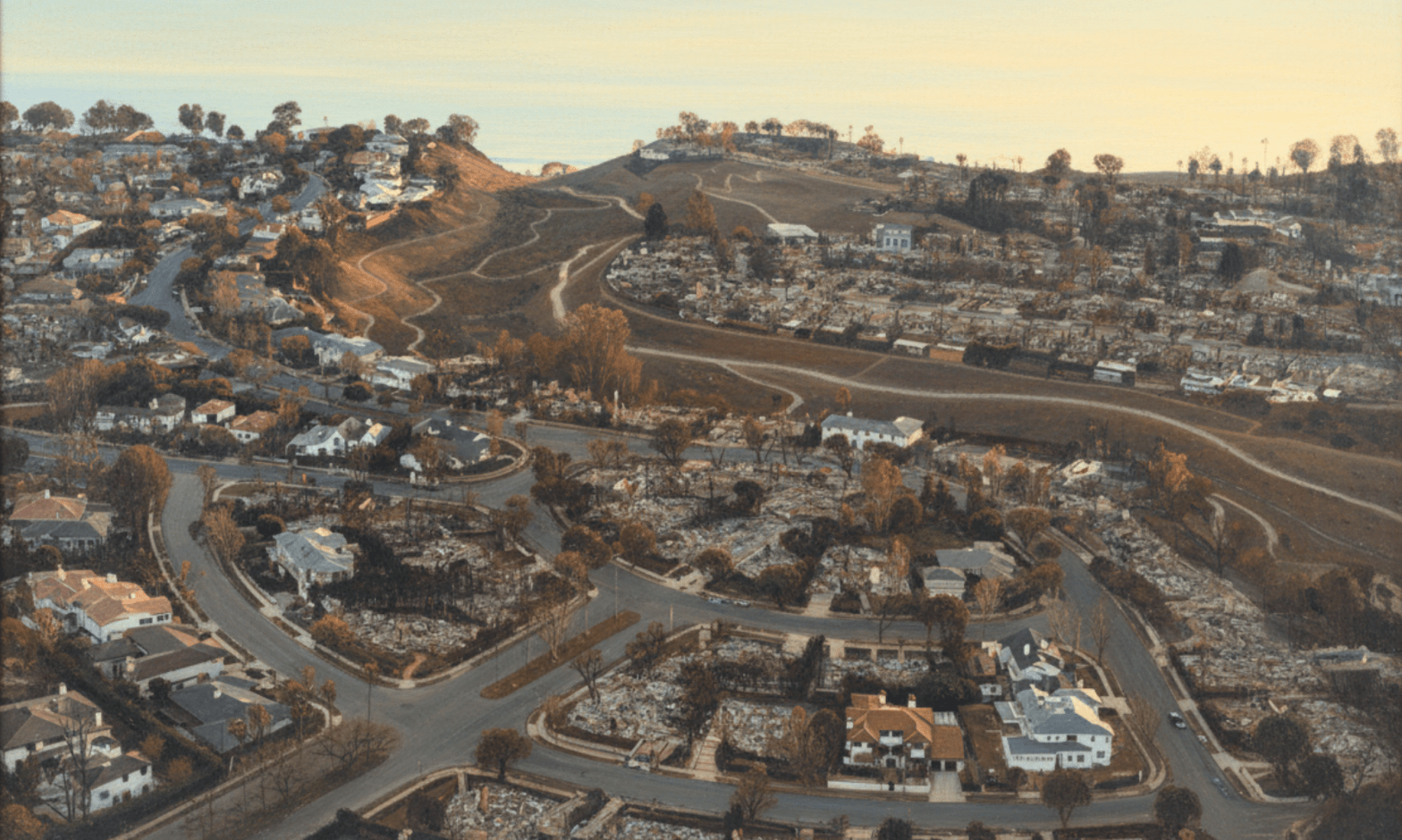
How can applied sociology inform disaster planning? Two sociologists from the USA, Assistant Professor Liz Koslov and Assistant Professor Kathryn McConnell’s research shows that ‘retreat’ strategies from wildfire don’t work. Instead, public policy must invest in better planning and community education.
Starting on 7 January 2025, and not contained for another 24 days, ending on 31 January, the wildfire known as the ‘Palisades Fire’ burned across the Santa Monica Mountains of Los Angeles County, USA, crossing into the Pacific Palisades, Topanga, and Malibu. The fire destroyed nearly 23,500 acres and 6,837 homes. Twelve people died.

Koslov and McConnell argue that prevailing public ideas about letting fires burn out have shown to be unsuccessful. They argue:
‘We need a serious discussion of how to live with fire in this new era. Today’s wildfires make clear that “let it burn” is not a realistic or humane response to the destruction of homes and communities — in either urban or rural places. These wildfires also make clear that the prospect of large-scale retreat from fire risk is a fantasy. Instead, we need greater investment in preparing our buildings, and community-led experiments in new ways to protect neighborhoods.’
The researchers have studied two established approaches to managing retreats from wildfire.
‘Managed retreat’ is when the government tries to buy land that’s at-risk of fire. This is ineffective for a range of reasons, including creating more vacant lots that become huge piles of kindling, and increasing vulnerability of unhoused people.
‘Unmanaged retreat’ is what’s happened in California, USA, in recent weeks, where individual households are displaced at the time of an emergency.
These sociologists argue for a new approach:
“Rather than dream we can retreat our way out of the crisis, we must relearn, and learn anew, how to live with fire. Many strategies are already known to help: hardening homes, growing fire-resistant residential landscapes, creating defensible space, prescribed burning, running power lines underground, investing in community organizations that can help disseminate information — and listening to and learning from the experiences of residents, workers and firefighters. Other strategies, like shelter-in-place building design, require additional research. All of these strategies require investments — many of which, as a recent federal report highlights, are not being made at nearly the necessary level.”
Read the research by Kathryn McConnell and Liz Koslov, ‘Critically assessing the idea of wildfire managed retreat’ (open access): https://iopscience.iop.org/article/10.1088/1748-9326/ad31d9
Credits
Photo source and read more of the NYT guest essay by Liz Koslov and Kathryn McConnell: https://www.nytimes.com/2025/01/19/opinion/los-angeles-wildfires-burn.html
The NYT article is behind a paywall. Tip: Local and state libraries often have subscriptions that allow free access to articles.
Discover more from Sociology at Work
Subscribe to get the latest posts sent to your email.
 Sociology at Work