
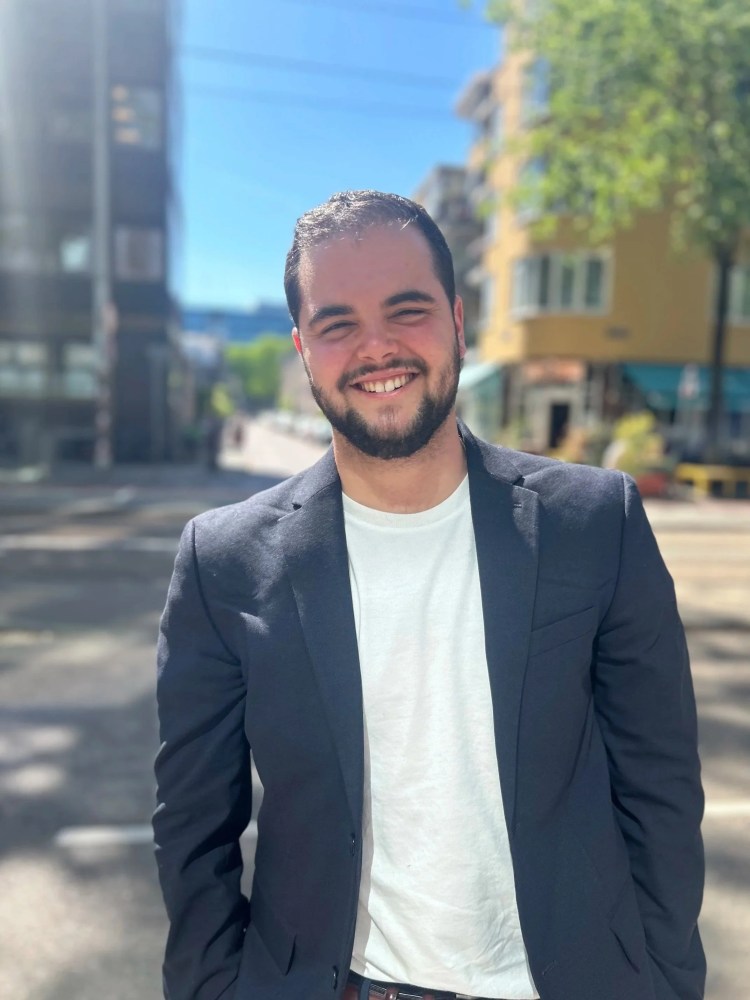
Parker Lemal-Brown is a sociology graduate from Bowdoin College who has worked in marketing and communications for social enterprises and in education, as well as creative development and production for television. He now runs Narrative Strategy, a content strategy consulting company. In January 2026, he will complete his Master’s in Persuasive Communication Science at the University of Amsterdam.
Q&A
You completed a Bachelor’s degree in 2018, majoring in sociology. Throughout your Bachelor’s, you had several casual and part-time jobs, such as research assistant, residential assistant, senior admissions interviewer, and other roles. How did your sociological training help you in these early jobs?
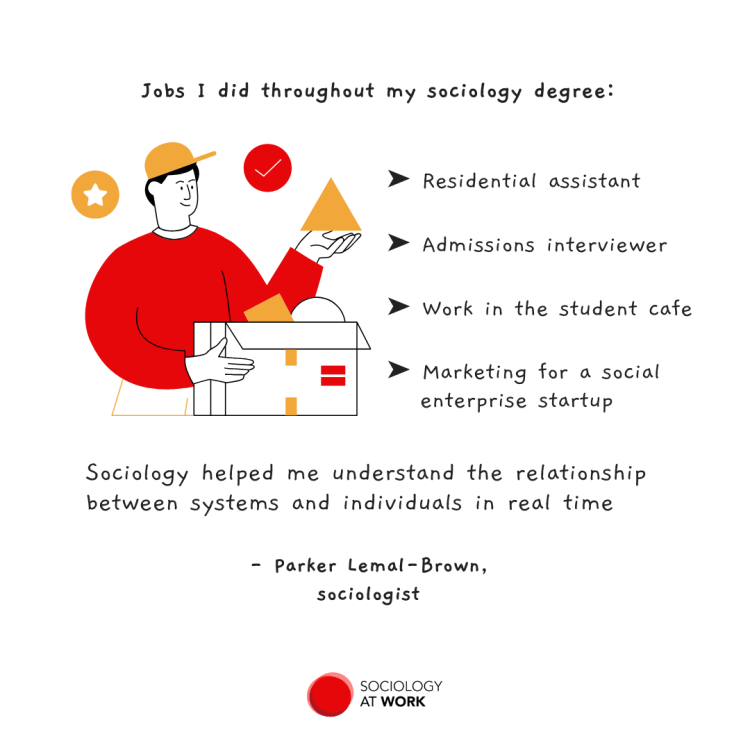
As a residential assistant, sociology helped me understand the relationship between systems and individuals in real time. For example, seeing how well college policies actually work (or don’t) in practice. I also was a student, so this position gave me a new perspective on my peers and how our choices are influenced by those around us – who could afford to take risks and who could not. I also helped first years from a range of backgrounds adjust to campus life. We were both building and reproducing a specific culture.
Being an admissions interviewer granted backstage access to the application process. There are unspoken aspects of the college image that are hard to convey in words, so finding the right “fit” with students can be complex and up to interpretation.
Working in the student cafe and at the dining hall also gave me a deeper appreciation for everyone who works at the college, especially during a strike in my senior year over living wages for staff members. We were learning about socioeconomic disparities in the classroom, but it hits differently after seeing how other students have to wake up at 5am to make sandwiches in order to afford their education.
While you were still studying sociology, you also completed two internships in marketing and in TV development. What types of projects did you work on, and how did these internships help you build up your sociological expertise?
My first internship was leading marketing for a social enterprise startup in San Francisco. I had just switched my major from neuroscience to sociology, which gave me more space to think abstractly and imagine solutions for systemic issues. Our platform connected grassroots nonprofits to donors, offering more choice of projects to donors and strengthening relationships through updates on the organisations’ work. I loved this experience, which sparked my interest in startups for social impact. It was really fun to be given agency early in my career to play around with ideas, build things from scratch, and see what sticks.
My first film internship is where I learned how to write script coverage, which is a report on submitted material being considered for production. Coverage is a natural bridge from sociology papers; I needed to critically analyse scripts and write my thoughts in a concise way – not just from an artistic perspective but also evaluating the quality of representation.
I could also flag problematic content, such as sexist, racist or other lazy tropes, and recommend not to move forward with that script. After studying the effects of stereotypes in class, it was cool to get to influence media representation directly, even in a small way.
Before working in writing and production, you had many interesting roles in entertainment, including as an executive assistant, a writer’s production assistant, and story analyst for the Black List, a writing platform showcasing TV, film, and theatre scripts. What types of tasks did you do in these roles and how did your sociology degree help your work?
Besides getting lattes and dropping off dry cleaning (my life was like The Devil Wears Prada with less glamour), I read a lot of scripts and wrote a lot of reports. My experience writing long sociology papers on a deadline gave me an edge with quickly analysing media to recommend to my bosses or giving feedback to other writers. Sociology is more of a perspective than a tool for me, a lens to see how daily decisions impact the stories we see on screen.
Working as an assistant also gave me direct experience with the Hollywood labour market and the gaps in the so-called “pipeline” that limit the types of people who get to make mainstream media. I came into the industry at the peak of #MeToo, then stayed through the COVID pandemic and the 2023 WGA writers’ strike. My sociology degree helped me contextualise these historical moments and the effects on my real life as well as my fellow assistants.
I recently got the opportunity to bring these experiences back to the classroom, by sharing an overview of Hollywood since 2018 and practical recommendations for making shows more inclusive for my Representation in the Media course in Amsterdam.

You have worked in creative development and production at Netflix, Amazon, NBC, Shondaland, and eOne. You were also a writer on Grease: Rise of the Pink Ladies on Paramount Plus, and you worked in the writers room for Bridgerton Season 3 on Netflix. What type of sociological research did you undertake in these jobs? Did you get a chance to explore sociological ideas in your writing for television, and if so what were these?
I got to explore a lot! This type of research was not just about finding historical facts and insights on daily life, but also helping translate this information into compelling stories. What tone do we want to strike? How do we balance accuracy with entertainment? Who has been historically excluded from these genres and how can we tell their stories in new ways?
I also wrote my own scripts, which gave me more space to explore sociological ideas. One pilot was a psychological thriller about the line between memory, identity and reality. Another was a comedy about a transgender figure skater and his mother, inspired by my own life. The script plays with Erving Goffman’s presentation of the self and Judith Butler’s gender as performance…in a fun way, I promise. I personally love sociological theory and find it inspiring for my creative work.
But as a writer, it’s also my job to turn theory into stories that anyone can enjoy, even if you’ve never heard of sociology in your life. Sociology and storytelling serve similar purposes – giving a new perspective that makes us rethink what we know about the world and people in it.
You have worked as a consultant in university and academic publishing, and now run your own consultancy. What does a typical day look like for a consultant? Can you share any examples of the outcomes you have contributed to that you feel best embodies your sociological interests?
It depends on the client and type of work, my days can be quite flexible. It could be a one-off project, like a pitch deck, or teaching a workshop on strategic storytelling. I typically sit down with the client, learn what they need, agree on a proposal and work on several drafts of the deliverable together. Sometimes I join as a short-term team member for an organisation, such as an incubator or startup. This lets me work directly with others and tackle multiple challenges at once. I spend a lot of time learning about new industries and how to apply successful tactics in different contexts.
I got to work with a circular fashion startup, which really stretched my sociological training. The circular economy, where waste is reused as raw materials for everything from clothing to construction, is still an emerging concept. Circularity is not as well-known as sustainability, which makes it an exciting area as a brand strategist. There are hundreds of circular projects happening right now, but still lack traction or haven’t hit the public imagination yet. There are a lot of questions still unanswered: How can circularity grow as a global practice without reproducing the inequalities of capitalism? What happens when we give new value to what we currently see as trash? Can there be economic growth without environmental destruction? These are ideas being constructed in real time. As a consultant, it is important to understand and critique what doesn’t work, but also help build something new.

In sociology, most graduates are trained on general qualitative and quantitative methods, such as literature reviews, interviewing, surveys, and fieldwork. Applied sociological work, which happens outside universities, often requires us to pick up additional methods. For example, you have worked in marketing and communications, delivering email campaigns and social media. For sociologists looking to get into this field, what new skills, software, or other technical skills would you recommend they might need to look into that they may not be exposed to in their sociology degree?
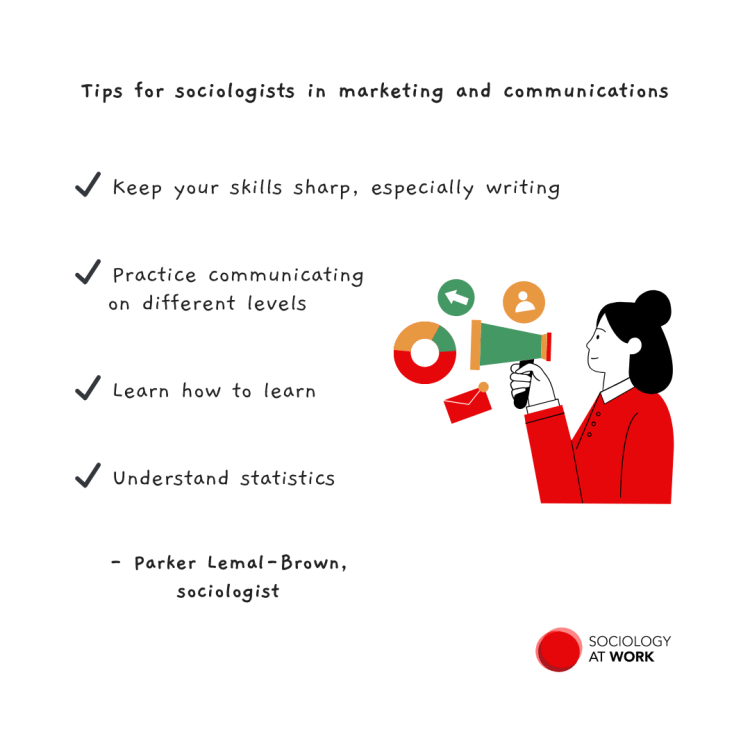
- Learn how to use AI, and when not to use it. AI tools are still a means to an end. It is important not to fear technology, but always question it. It will likely be at the core of marketing and social media within the next few years. Even as a writer, I’ve learned how to create AI generated videos in order to explore how it could impact independent artists or change the creative process.
- At the same time, it’s good to keep your own skills sharp, especially writing. Knowing how to articulate your own thoughts (out loud and on paper) is always an advantage, no matter how technology evolves.
- Practice communicating on different levels. That means being able to write a one-sentence email as well as you can write a 10 page paper. Know what your point is and when to elaborate. Deeply understand what you are saying, so you can say it simply. Talk to people from different departments. Understand their lingo. Listen and absorb what people say.
- Learn how to learn! Pick up a new skill from scratch, whether it’s a language, software, or rock climbing. You will always have to learn on the job, we all do. It is even more crucial now as technology accelerates. Learn deeply and quickly.
- Understand statistics, or at least get comfortable with data. I did not receive much quantitative training in my sociology degree and finally got the chance in graduate school. Even if you will not have to crunch numbers yourself (thanks to AI), stats can boost your “hard” skills, confidence, and ability to unpack data in marketing or news articles. I used to find data analysis intimidating, but now I know more about how data gets collected and framed to become what we see as “facts”. It is harder to be blindly persuaded when you understand the process.
How do you fuel and recharge your sociological imagination as a practitioner?
Living in Amsterdam helps me constantly question the reality I took for granted, especially growing up in the United States. As one of the few Americans, it has been refreshing to see what is common across cultures, but also the many different ways systems can be built. There are more choices for me here: I can walk, bike, drive, or take a tram most places in the city with similar levels of safety and time, which was almost impossible in LA.
The golden rule of writing is “show don’t tell”: with my sociology training, I’m more aware of how urban design and culture set the stage for small moments in my life. There is a blend of solutions for social issues, from startups to public government programs to homegrown community initiatives in each neighbourhood. These elements weave together so I always feel part of something bigger than myself.
As a queer trans man, I am also getting the chance to see my own identity in a new way. I feel seen as a complete person, rather than a collection of labels. I do not need to compromise myself or prove my “value” in order to feel safe, as I often did in the USA. I am constantly thinking about how we collectively create social value and how we can protect each other (and the earth) in turbulent political times like this.
Do you have any practical advice for sociology students and recent graduates who want to pursue a career in entertainment and consultancy?
There is no one way to work, in entertainment or consultancy. You can take a formal route, climbing up the ladder in firms and studios, or build your own business as a freelance entrepreneur or independent filmmaker.
The best way to start is to learn from experience, wherever you are. Write a script, work on a set, help produce a short film. You can practice writing coverage by finding a screenplay online and summarising it in one page (try it first without AI). Watch video essays and tutorials, that is how I learned screenwriting. For consulting, you can start by offering to share your past experiences, maybe with college applications or how you chose your major.
Share what you’ve learned in life with those who want to hear and get people’s feedback on your advice. Be curious, humble, and open to learning from any kind of experience. Keep your interests broad, but spend time crafting a specific set of skills. That is what builds expertise over time.
Finally, where can we keep up with your research and activities?
You can learn more about my work at narrativestrategy.co. I love to do workshops and guest lectures for students in the social sciences. Reach out if you want to work together! You can also check out the new podcast Dinner Club with Kai and Parker, which I co-host with my friend and leadership coach Kai Kaldewaaij.
I am currently working on a long-term passion project called Future Solutions. This project is a compilation of social theory, startups, and communities trying to make the world a better place. I am interested in studying the growth, communication strategies, and potential connections between these ideas. If you are interested in learning more or getting involved as a researcher, send me a message on LinkedIn or reach out through my site.
Keep doing incredible work, the world needs more sociologists!
Thank you for sharing your amazing career journey and wonderful skill set with our community!
Credits
Header and bio images: original photos of Parker via Narrative Strategy.
Discover more from Sociology at Work
Subscribe to get the latest posts sent to your email.
 Sociology at Work