This is a round-up of media stories on applied sociology from the past year. We showcase the achievements of sociology students. We then look at the careers of sociologists working in education, social policy, health, and the arts. We review examples of sociology in the workplace and how sociology transforms social policy. We end with examples of how sociology is translated for new public audiences. This post gives an eclectic overview of sociological practice. Perhaps it will ignite your sociological imagination on a new career pathway for the year ahead!
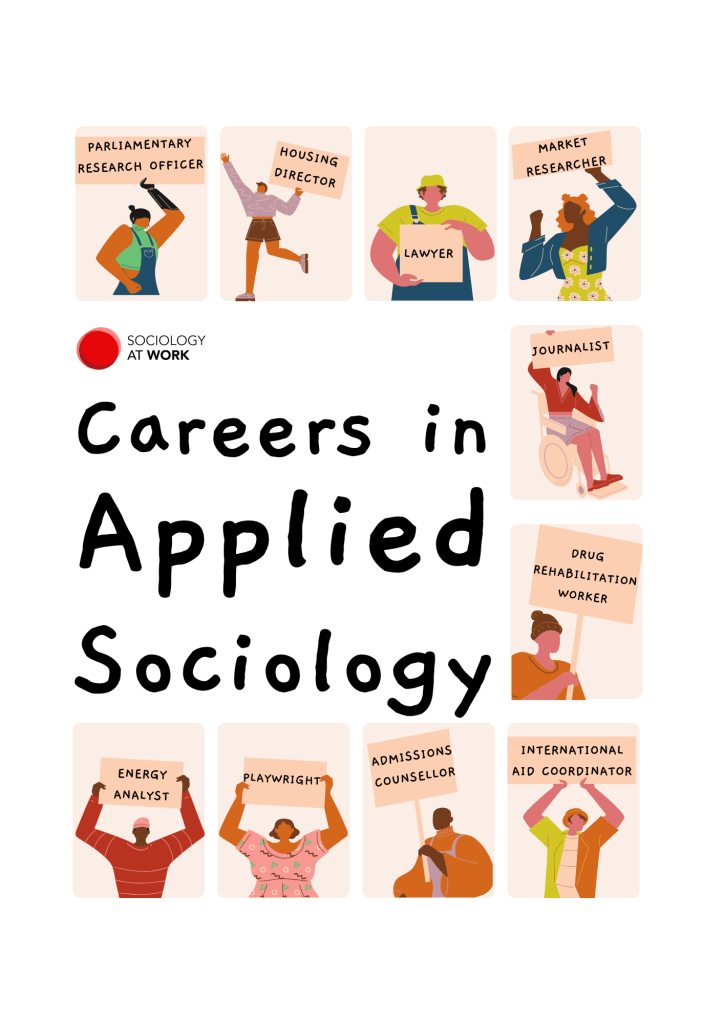
For educators, we include a printable A3 poster of the applied sociology roles discussed throughout this post.
These stories were featured on our social media. If you’d like to get regular news on the impact sociologists make in the world, join us on BlueSky, @SociologyAtWork.bsky.social, or our community on LinkedIn.

Sociology students
American sociologist, Professor Deborah J. Cohan, provides examples of how sociology helps students as a major or minor subject.
“Sociology helps to build the empathy muscle, which is essential for living in a community.”
Councillors call for sociology in schools in Donegal, Ireland:
“Sociology and politics are one of the most important subjects. It explores how decisions are made and how politics works… this subject is essential to improve female representation in politics.”
High school sociology students in Gibraltar presented their research projects to the Minister for Education: “They provided information and data, as well as feedback from students and teachers, that are very helpful in developing policy.”
PhD student, Aniruddha Mahajan, on Indian Students in the UK diaspora: “A simple query about funding becomes a disciplinary act, reorganising social relations along caste lines.”
Indian sociology student, Mubashira Patel, aged 26, from Mumbai University, was awarded the 2025 Srinivas Rayaprol Poetry Prize. She was selected from among 126 entries. The prize recognises excellence in poetry written in English by 20-40 year olds.
Zimbabwean sociologist, Mavis Soko, completed her PhD on women’s sexual autonomy. “Academically, I aim to contribute to the growing body of knowledge on intersectionality, gender and sexuality in African contexts, highlighting the importance of considering ethnic and cultural dynamics in public health and social policy.”
American sociology student, Samuel “Sammy” Chavez, is completing his degree as a mature-age student, while working full-time as an outreach specialist. “Education saved my life. Without school, I probably would still be doing construction, and I don’t know how much longer my body could do that type of work…. Education is something that can never be taken from you.”
Visual University Space is a multimedia exhibition by students sharing their research on oral life histories from ten states in India.
Applied sociology careers
A careers panel showcases sociologists working as a city housing director, an international aid worker, journalist, lawyer, and market researcher:
“Sociology is a ‘superpower’ that allows people to understand how organisations and people operate on a deeper level.”
Sociology graduates discuss their careers in nursing and statistics:
“It’s given me the space to keep exploring how to be a better storyteller with data and how to bridge complex analysis with narratives that resonate beyond academia.”
Sociology graduate, Dani Chase, worked as an admission counsellor, and volunteered on a local human rights steering committee. They discuss how their sociology degree supports their advocacy work:
“I came back to school to help my community. In this age of record-breaking amounts of violence and legislation against trans people, I wanted to do something.”
Vanya Singh, sociology graduate and playwright, reflects on using sociology in theatre.
Sociology at work
In January 2025, Brazilian sociologist, Professor Nadya Araújo Guimarães, reflects on her career analysing the working conditions of caregivers and domestic workers.
“I discovered that informal workers, such as street vendors and domestic workers, developed strategies for solidarity and collective action, even without relying on the infrastructure of trade unions and solid ties to companies.”
In late June, South Korean American sociologist, Gi-Wook Shin, discusses his study on the recruitment patterns in China, Japan, India, and Australia. These nations share four strategies: brain train (developing domestic talent), brain gain (attracting migrant workers), brain circulation (bringing back nationals who moved overseas), and brain linkage (transnational collaboration). He says:
“There is no ‘one-size-fits-all’ path to development […] Rather, the ‘talent giants’ have developed distinctive talent portfolios with different emphases on human versus social capital, domestic versus foreign talents, and homegrown versus foreign-educated talents.”
In mid-October, a national conference finds there is a lack of research on nursing education in Nigeria. Sociologist and nurse practitioner, Professor Prisca Adejumo, emphasises “the importance of research in advancing the nursing profession.”
Also in mid-October, British sociologist, Dr Alex J. Wood discusses the changes needed to protect freelance workers:
“It must come through a system that guarantees democracy in the workplace.”
In early November, American sociologist, Dr Ashley Railey, discusses the benefits of collaborating with rural communities to address substance use:
“Community-academic partnerships are valuable for translating research into practice, but require more than just providing the results to the community.”
In mid-November, American sociologist, Associate Professor of Public Policy and Urban Affairs and International Affairs, Laura Kuhl, who has a Bachelor’s in sociology, is co-leading multidisciplinary research to support coffee farming:
“Understanding farmer management strategies has really important implications for our broader understanding of farmer decision-making in socioecological systems.”
Again in mid-November, an article asks: how does sociology help shape energy equity in electric power engineering?
“By establishing a comprehensive framework that integrates technical and sociological elements, we can begin to transform energy equity from an abstract concept into a practical reality.”

Sociology in policy
On 1 July, First Nations sociologist from Australia, Palawa woman, Professor Maggie Walter, along with four other Commissioners, led delivery of the final report by the Yoorrook Justice Commission. This is Australia’s first truth-telling inquiry into the historic and ongoing systemic injustices perpetrated against First Peoples through colonisation. The report finds that the State of Victoria committed genocide, land theft, and colonial invasion. Professor Walter was pivotal in embedding Indigenous Data Sovereignty principles into how evidence was gathered, stored, and owned (see pp. 150-151).
Professor Walter and two other Commissioners “did not approve of the inclusion of the key findings in the final historic record.” (This record is a separate report that summarises themes from oral testimonies given by First Peoples during the public hearings.) “They urged readers read the report’s findings along with Yoorrook for Justice (2023) and Yoorrook for Transformation (2025).” The Commission was the first step in the Treaty process. The Statewide Treaty Bill was passed on 16 October, and Treaty officially commenced on 12 December. This makes Victoria the first Australian state or territory to have a Treaty with First Peoples. Australia remains the only Commonwealth nation that does not have a national Treaty with First Peoples.
In early November, Canadian sociologist, Associate Professor Ardath Whynacht, criticises the Canadian Parliamentary Committee request for research grant data:
“The original motion revealed that many MPs have a cavalier attitude about violating Canadian’s right to privacy when they want to engage in political witch hunts.”
In mid-November, Irish sociologist, Dr Maria Quinlan, showcases the lived experience of people who are homeless in a new exhibition in Cork city, Ireland.
Also in mid-November, Canadian sociologist, Professor Barry Eidlin, gives policy advice to the Canadian Senate, on labour rights and worker strikes:
“While the careful work we do as social scientists, poring over data and publishing our findings in peer-reviewed journals, is essential, it is also vital to use our knowledge and expertise to shape public debate on the critical issues of the day.”
At the end of October, American sociologist, Professor Jennifer K. Montez, on increasing mortality rates:
“If we’re going to communicate this to policymakers, it has to be in a metric that is motivating and that they can really wrap their heads around.”
Translating sociology
In early September, British sociologists, Associate Professor Ali Meghji and Dr Iris Pissaride, discuss how W.E.B. Du Bois’ sociological practice enriches academic sociology. Meghji additionally draws on the work of Priyamvada Gopal, regarding “reverse tutelage.” That is, how academics might enhance their practice by learning from the public:
“So, one of my arguments is that we need to also think about the alternative flow of knowledge: that is, the flow of knowledge from publics to academics. That would actually make public sociology properly dialogical, because it would be accounting for both flows of knowledge. So reverse tutelage, in the way that I use it, refers to the flow of knowledge from publics to professional academics, where professional academics realise that much of their knowledge about central processes and relations could be enriched – to come back to what we were saying earlier – if they would listen a bit more explicitly to these counter publics.”
At the end of October, American sociologist, Associate Professor Alexandra J. Ravenelle’s, work on the sociology of the gig economy inspires the recent Hollywood film starring Keanu Reeves:
“The film is validating and really shines a light on how hard it is for many of these workers.”
Discover more from Sociology at Work
Subscribe to get the latest posts sent to your email.
 Sociology at Work