
I often get emails from sociology graduates interested in setting up a consultancy business as an applied sociologist. Below are some broad tips showing how I got started as well as some resources where I’ve answered typical questions about my work trajectory. Everyone’s needs and interests will be different, so this is not intended as an exhaustive guide, but rather just a few general points to consider. Do what works for you!

I also provide this advice with a word of caution. While it’s not outside the realm of possibility, it’s unlikely that a graduate fresh out of their Bachelor’s degree will be best placed to start a consultancy without other experience. I had worked for a decade post-PhD as a professional applied sociologist before I started working as a consultant. This meant I had many publications and a wide breath of applied skills I could demonstrate to potential clients, having already worked in social policy and not-for-profit organisations on a wide range of projects. I had also volunteered extensively and had built up a professional social media profile before I launched my consultancy.
Even still, I invested around a year getting myself and my business ready. I am risk-adverse, though, and if you have a financial buffer, then dive in as soon as you feel ready!
It’s best to be realistic and get other experience as an applied sociologist, which you can then use in your consultancy work. For example, you might apply for individual grants to deliver small research projects. State Libraries and community organisations run these opportunities annually.
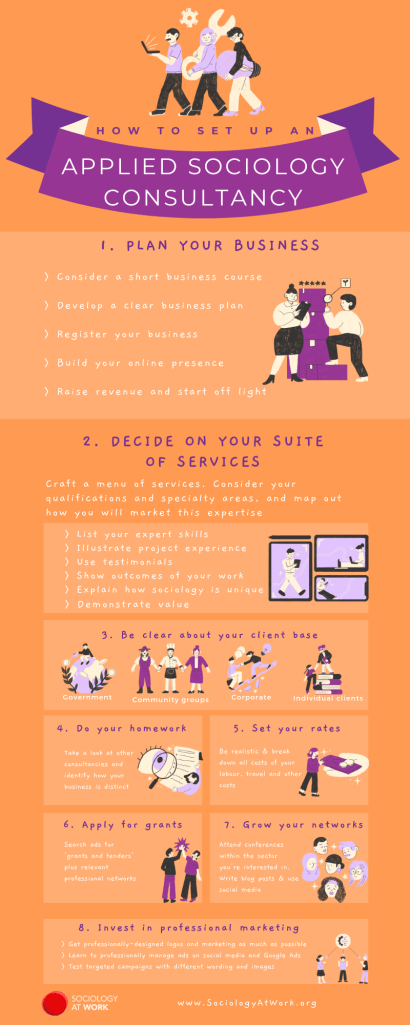
1. Plan your business
I did a short course on how to run a business that was critical for me to get started as a consultant, as it covered issues like legal requirements, budgeting, professional indemnity insurance, business taxes, project plans, and more. Local libraries and community organisations will sometimes offer these courses free, and there are often government schemes that might provide these courses and accreditation free or subsidised. See what’s available in your city.
Develop a clear business plan. This should include a clear vision for your consultancy, such as the types of clients you will approach. Itemise all the costs of running your business, the number and types of jobs you’re aiming to achieve each quarter, the revenue you expect, marketing costs, and other expenses.
Register your business with your national taxation office, secure the naming rights to your business, and ensure you’re aware of what other requirements you need to fulfil to run a legal business in your country.
Think about branding early on. Come up with a meaningful name for your business that is clear and simply communicates your services. Avoid acronyms and try to describe your skillset, and perhaps your location, as these are keywords that clients will search online. Pick a name that is not already licensed. Avoid a name that is too similar to competitors. Branding is pivotal to your success, because this is how you establish market trust.
Build up your online presence. Clients will most likely advertise consultancy jobs online, or use Google and other search engines to find service providers. It’s tough to break into the market without a website. I am self-taught and run several websites, so setting up my consultancy’s online presence drew on an existing skill base. If you don’t know where to start, click on the tips below.
Tips for setting up a business website
As part of my consultancy, I ran website and social media services. I have also managed sites and communications for large organisations and government agencies. Here is my advice if you’re new to communications management. Whatever option you go with, ensure your website is mobile responsive, as the majority of people, including potential clients, will view your site on a smart phone.
Website address: This is known as your ‘domain’ or URL. (E.g. SociologyAtWork.org.) It’s a good idea to buy the domain that matches your business name. In fact, I suggest checking whether the name you want for your business already has an associated domain. If it’s available, consider snapping this up, even if you aren’t quite ready to set up a website. I suggest sticking to .com domains for a business, or your national variant <.com.au>, as most clients prefer to work with locals. Avoid using the .org domain unless you are a not-for-profit.
Simple website: If you want to create your own website, using existing templates and software, I recommend WordPress. I’ve built websites on many content management systems (Joomla, Blogger, Tumblr, and more), but prefer WordPress, as the backend is intuitive and easy to use. You can buy a domain name through WordPress (AUD$30 annually). While there is a Free plan option, I recommend a Personal Plan to remove irrelevant advertising, or a Premium Plan if you want to accept payments online. (Note, I don’t accept payments via my website, I use PayPal to send invoices and receive payments.) Note that you will be somewhat limited in the design (‘templates’) and functionalities (‘plug ins’). Still, there are over 1,000 free templates. This website you see here is a Premium plan, which removes ads, and allows video upholds.
Flexible website: If you want more control, then get your own webhosting, but this will require more skills and costs at least AUD$400 for three years. (I previously self-hosted via BlueHost, but later moved hosting to WordPress.com.) Self-hosting allows you to buy your own templates, add unlimited plug ins, and greater customisation, such as colours and fonts. If you’ve never built a website, I suggest looking at online tutorials first to get an idea of the upskilling required.
Professionally-built website: This is the best option if you struggle with learning new technologies, or if you lack time. You can expect to pay at least AUD$3,000 minimum for a basic website built by professionals, plus the cost of your domain, hosting, and privacy. Bear in mind that there may be ongoing costs for maintenance. I’ve also worked with clients that experienced problems when they wanted to upgrade their website, or change providers, so do your research about what is, and is not, included in website design.
Raise revenue and start off light. Most consultants will work in other jobs at least part-time, usually for a couple of years when they are first establishing their business. It’s a lot of work to start your consultancy, and you will need income to get it up and running. Perhaps consider taking on small jobs at first, or do whatever makes sense for your situation.

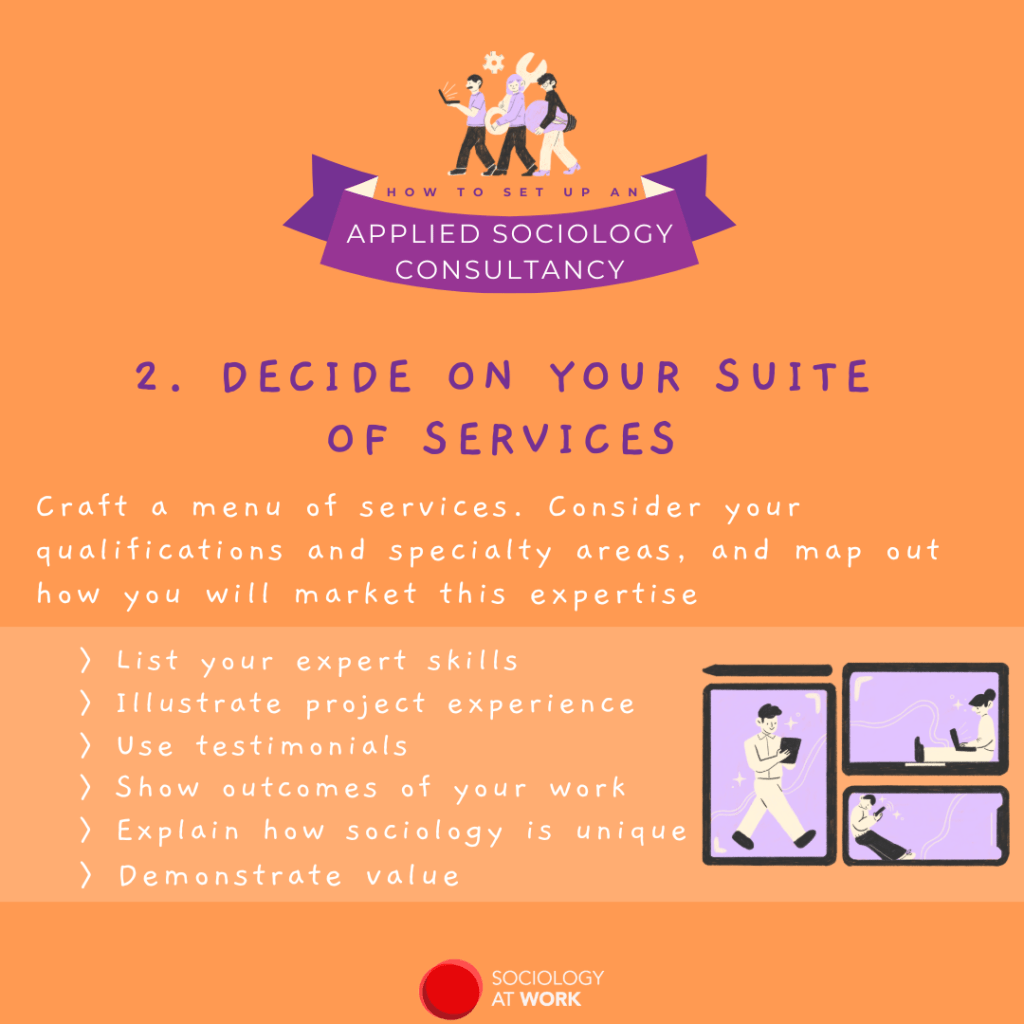
2. List your suite of services
Craft a menu of services
Think about the broad areas you are qualified in and then map out how you will market this expertise. Make it clear to non-experts.
For example, list skills that the general public is familiar with (surveys, interviewing, report writing) rather than sociological jargon (ethnography).
Your website or other marketing should show how you, as a sociology expert, can deal with specific workplace issues.
Demonstrate your expert skills
Do you specialise in specific methods, theories, or tools? If so, how will you “translate” these into a corporate, policy, or community space?
List your skills in plain language and use bullet points to show how these link to specific organisational problems. Think in broad terms: health, environment, anti-discrimination, and so on.
For example, if you run surveys, how do quantitative sociological methods relate to and enhance company interests to increase the number of minorities and white women in senior roles?

Illustrate your project experience
Can you do research on specific corporate issues? If so what issues and how can you address these through your consultancy?
Provide a mini case study (described in a few sentences) outlining the problem, approach, solution and client or sector to convince your client to hire you for their project.
Use testimonials
Can you deliver training? Which organisations have you trained in the past? What type of training can you offer?
Getting a quote from a named individual and their organisation endorsing your skills would help to market your business. Reach out to a past employer, client or colleague.
Show specific examples of your work
Can you do evaluations? How, for whom, and where did you carry this out?
Linking to your published reports or articles (not necessarily an academic publication) would help build confidence that you’re the applied sociologist for the job.

Explain how and why sociology is unique
Can you deliver strategic policies? Have you worked in local, state, regional or federal government?
Writing short, accessible blog posts discussing a social policy problem using sociology is an effective way to persuade clients to choose your consultancy over others.
Demonstrate where sociology brings value
Can you do lead interviews? Great – so do many other fields, with market researchers dominating commercially. Why does a client need a sociologist? Explain briefly what sociology brings to the job, and reassure that you can deliver practical solutions on time and in budget.
Think about how your skills directly relate to the types of services you can provide different client groups. Show specific examples of your experience or related work as a sociologist.
Tips for demonstrating your value
Give examples of tangible outputs. Explain where and how your past work has helped clients, and why sociology was pivotal to success. For example:
- Concrete outcomes: ‘Increased customer satisfaction of Big Tech Solutions by 15%’
- Savings to the company: ‘Saved $10,000 by enhancing the auditing of standard operating procedures’
- Client engagement: ‘Doubled registration of services for Local Communities Organisation within six months’
- Program or policy enhancements: ‘My client report informed recommendations in childhood education in Melbourne’
3. Be clear about your client base
Know your target audience, whether it be government, community organisations, private industry, or other sole business owners.
Many consultants who are starting out will make the mistake of saying they can work for anyone. It’s unlikely that a company will hire someone who claims to cater to a broad client base, because they are usually after specialised services.
If you want to work on development issues, most of this work is managed and funded by government agencies. So be sure to tailor your services to them. Corporate companies would expect a different suite of services. So do your homework.
Clients will want to see samples of your work, so be ready to provide an Executive Summary of past reports or projects, or build an electronic portfolio of your work.
This could be samples of your client reports or corporate presentations or other outcomes that you can compile and share via private links, your website or elsewhere. (Most small businesses use Google, while government organisations use Microsoft 365. Make sure they can open your link safely, by having good cybersecurity practices!)
Think outside the box and present your portfolio in a visually appealing way. You can do this on your blog or use SlideShare and other features on LinkedIn, such as articles.
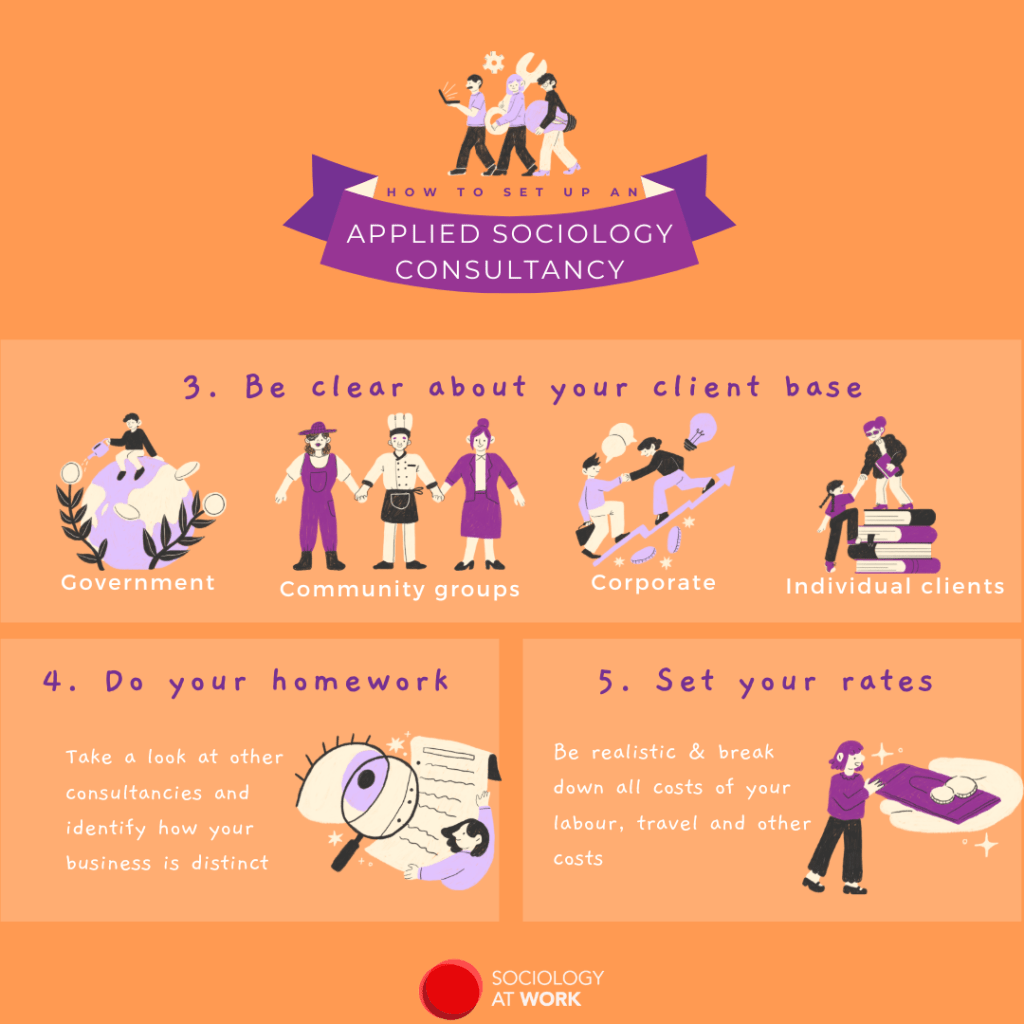
4. Do your homework
Take a look at other consultancies in your city or country and find out what your competition already offers. They may not be sociologists, but see what services they provide to which companies, and be really clear about how you are similar or different. You should not publicly compare yourself to them, but you should be clear in your own mind about how your services are distinct. This will also help you in setting your pricing.
It goes without saying, but never disparage other businesses, even if you are asked to comment on other service providers. Be professional and clients will appreciate your discretion, as they will be looking for a consultant who can best represent their interests.
5. Decide on your hourly rates
Be realistic. As above, see how much other consultancy companies charge. Don’t set your price too low, but don’t set it too high when you’re first starting out. Value your expertise. Decide on whether you will operate on a sliding scale, charging more for larger companies, and perhaps less for community organisations or not for profits.
Tips on setting your rates
Depending on the services you offer (say, interviewing versus corporate training), and comparative prices in your home city, you could be charging anywhere from AUD$20 to $30 an hour when you first start out (‘early career’), to AUD$80 to $120, or more, for specialised consulting if you’re providing training, corporate policy advice, or delivering complex research reports (‘senior to executive’). If your country has a lower base rate, you need to work that out for yourself.
Below are some considerations for your rates, but please do your own research, factoring in your expertise and services. Bear in mind that community organisations rely on donations and temporary funding, so they will pay far less.
Mid-career (five to ten years industry experience): I have procured many contractors for research services. Large government organisations might pay AUD$40 to $60 an hour for basic research services to a consultant with a PhD who has at least five years’ relevant work experience. This might be conducting literature reviews, or analysing existing data owned by the client (e.g. interviews and surveys).
Senior to executive (at least 15 years industry experience): For a large, complex project that requires a researcher with extensive experience, the rates will be up to the high end, as above. This might involve carrying out a study from start to finish, such as running community consultations and delivering a report with policy recommendations.
Pricing: My consultancy preference is to avoid hourly rates. Instead, I quoted a price for the entire job, being clear to spell out individual costs. You need to be realistic about how quickly you can deliver a polished product. When you are still building up experience, a good way to practice is to carry out small research projects for yourself, that you might publish on your website as a way to build your brand. Log your daily hours to see how long each component takes (e.g. literature review, data collection, analysis, write up, proof-reading, design, and publication). I use Clockify to track my projects.
Costing additional expenses: If you charge for travel and expenses, be explicit in your initial quote, and break down the budget for the number of hours, include how many drafts and revisions are included in the price, stipulate intellectual property rights (note that most companies will want to retain IP), and other costs, especially if the job is more complicated.
Pro-bono work: I run a few not-for-profits, and I do not charge anything, and I absorb all the costs (this website is one example). However, in my consultancy, I did not offer free services. It’s up to you what you do, but consider that “exposure” doesn’t pay your bills – consultancies have running costs. Companies rarely value something they get for free and it’s unethical to expect people to work for nothing. But some consultants might trade their services with other businesses when they’re starting out (for example, a bit of research for graphic design). It’s up to you where you land on this, so do what’s right for your circumstances.
6. Apply for grants
Most government agencies and corporations will not accept unsolicited proposals. Instead, they will advertise opportunities through media (search for ads called “grants” and “tenders“), and via relevant professional networks. You will need to keep looking at these sources, and their websites and social media to see what opportunities are out there.
Sign up to as many newsletters as possible, and when contract work is advertised, respond with a professional brief showing why you’re the best consultant for the job. Keep it short, one to two-pages, or otherwise stick to their guidelines.
Most professional sociological associations in Australia and elsewhere will advertise job notices through their newsletters. The majority are for academics, but occasionally contract work will become available. Stay connected to see what opportunities become available.
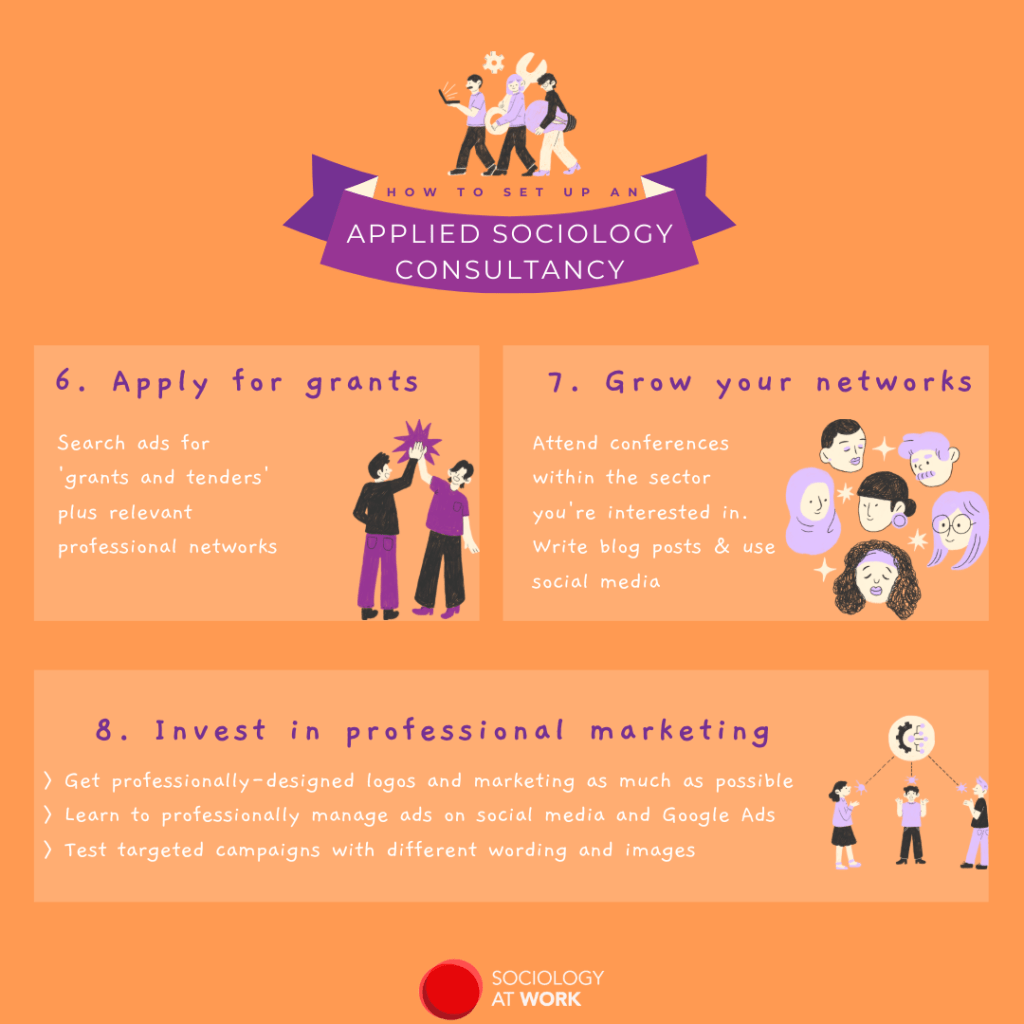
7. Grow your professional networks
Academic conferences are unlikely to lead to paid consultancy work. Having said that do let people in your network know that you’re interested in constancy opportunities. Sometimes academics can offer you work or pass on jobs they can’t do. But just remember that the work of consultants is very different from academics, and that means engaging with other networks.
Attend conferences within the sector you’re interested in. These are not the same as academic conferences. They tend to be more focused on applied issues rather than theoretical papers. Join professional associations in the sector you want to target. Present case studies of your work, or focus on how you can solve specific social or corporate problems.
Link with relevant agencies and professional associations for the sector you’re interested in servicing. Use social media to make useful connections, especially LinkedIn. Remain professional and on topic when you post. Avoid personal rants.
Write social media and blog posts showing your expertise in the areas where you want to attract clients. Having your own established blog with an audience is a good way of showing editors and potential clients that your knowledge is valuable.
You might consider pitching op eds to newspapers and other media publications that directly relate to the clients with whom you want to be working. Pitching is a specialised skill, so read on how to do this effectively, and keep trying. Don’t let rejection or non-response get in the way (but don’t harass editors either!).
Use plain language to show how sociology can answer important questions, focus on practical solutions, and make sure you link to your consultancy website in your bio.

8. Invest in professional marketing
Pay to promote your consultancy. When you’re first starting out, it can be very tough financially, but it’s unlikely that you’ll succeed as a consultant without paying for advertising. If you can invest in paying an experienced marketing company, great. Otherwise, learn how to professionally post paid ads on Facebook and Google Ads. They have dedicated resources and staff to help you get started.
All of my clients came through Google Ads initially, and then word of mouth as those satisfied customers told others in their networks.
Tips for marketing
Use professional design: Your branding is important, so invest in professionally designed logos and marketing as much as possible. It will pay off in the long run. Search online for a local designer, or post your requirements on websites such as 99 Designs. Make sure you get the original design file of your logo as part of the delivered outcome (e.g. AI or EPS file), not just the final version (e.g. PNG, JPG, or PDF version). This will make it easier to resize for different mediums, or adapt your logo over time.
Printed materials: Paying for professionally printed business cards, postcards and other advertising materials is also a good idea (this is known as “collateral”). You can always hire a graphic designer. There are many small companies that have a range of cost-effective options for small business owners. Otherwise, watch online tutorials, and learn how to use Canva, or other online services.
Send mail outs: Alternatively, if you are very good at design, create and print your own materials. Moo.com are economical and elegant, Snapfish or a similar service have a range of options, or try a small business in your home city. Leaving printed materials in letterboxes, libraries, or businesses is surprisingly effective. (I did this and found it valuable.)
Test: Google Ads and social media platforms allow you to test targeted campaigns with different wording and images. Avoid the hammy marketing lines you’re used to seeing – they rarely work. Put sociology to use, and appeal to social norms, altruism, and solving problems.
Avoid using AI: Generating your logo and other branding, collateral, social media, ads and other marketing exposes your business to data theft. Ownership may become murky, or you may end up with a generic design that harms your business in the long run.
Good luck!
I won’t be able to help with individual questions about the details of your business, but I hope all this advice at least helps get you started. It’s okay to take your time to plan the set-up of your consultancy. Consider setting up your online presence for at least a couple of months before formally launching your business, so you have “live” examples of what you can deliver, even if it’s just a few articles.
Good luck applied sociologists! Check out more resources further below.
Resources
Interviews about my consulting work:
- Turning Social Science into a Business
- Two-part interview on my consultancy on gender equity and the challenges and opportunities of this career path
An example of how to blog as a consultant:
- Social Science Insights contains examples of my consultancy projects, as well as reflections on my work as an applied sociologist. My blog was referenced by clients who hired me, so it will give you a flavour of how to write for corporate and policy audiences.
A different example of working as a consultant:
- Applied sociologist, Dr Karina Butera, wrote about her consultancy as a life coach for Sociology at Work, showing how she turned the topic of her PhD into a business. She provides advice that might help you branch out into specialised services you might not have considered.

Discover more from Sociology at Work
Subscribe to get the latest posts sent to your email.
 Sociology at Work