
Volunteering is an important way to build applied sociology careers. Let’s explore how giving practical talks to community groups can improve both communities and our sociological practice.
Voluntering is a useful way of giving back to communities, and practising sociology. It’s also another way to get more work experience in a new area. Today’s post starts with a case study of a talk to a local community. We then dive into an example of how to use social media volunteering to grow work experience. Finally, we look at how to represent your volunteering in your CV.
If there’s a cause you’re already involved with, or a career path you’re interested to get into, here are some ways that you can integrate your volunteering with your professional growth.
Case Study: Talking to a local club
Sociologist, Dr. Ray McDonald, Assistant Professor at Wiley College in the USA, gave a talk to his local Lions Club. His talk focused on practical research outcomes regarding Alzheimer’s Disease. The novel aspect of his talk was how he blended sociological ideas with lifestyle tips.
During his talk to an elderly community group at the Lions Club, McDonald noted that, as harrowing as Alzheimer’s is, the disease more or less follows set patterns, increasing in severity. There are medical and social programs to try to improve quality of life and to manage the disease. As he was speaking to a group who are likely to be future carers of loved ones with dementia, McDonald did not simply focus on describing the disease. He highlighted the specific skills and resources that carers might draw on to help their own health.
Research shows that carers’ health will change drastically because they are not focused on their own wellbeing. McDonald provides practical tips, suggesting carers take regular 15 minute breaks, making the time to play games or to learn a new skill, and reaching out for professional support, such as counselling to deal with the stress and emotion work involved in care.
These suggestions may seem simple, but they are informed by sociological research, and presented in a way that makes carers’ work seem a bit more manageable.
How you can present to local groups
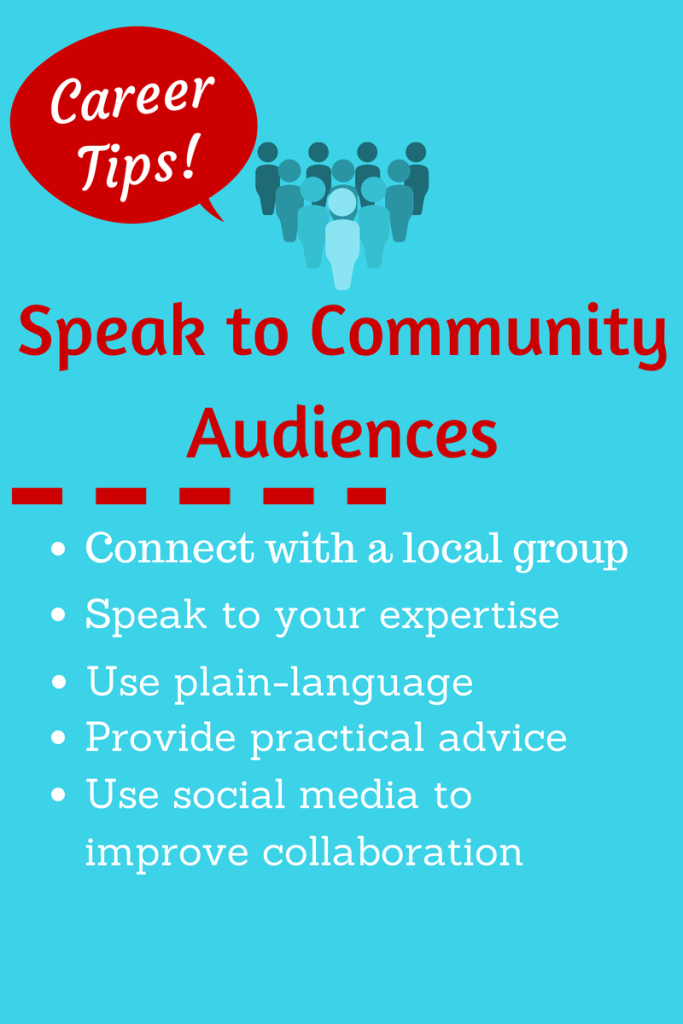
Most of the time, sociologists present research only to professional audiences, such as other academics, or in the case of applied sociologists, to government and industry audiences. Presenting research to community audiences in plain language is an important professional skill.
Many applied sociologists will deliver community workshops and consultations as part of their work. Volunteering is a way to build up this experience. For example, you might promote your free services to your library or other local community groups. Not all of us are in a position to join a regular volunteering position. If there is a community cause you care about, but you have limited time, offering a once-off talk or a monthly seminar may be more suitable.
Don’t create extra work for yourself by creating text-heavy PowerPoint/ Prezi presentations. In many cases, lay audiences are bored by slides, so keep these to a minimum, such as half a dozen data slides and a list of tips your audience can try at home. Speak plainly to local groups about research insights about sociological issues, or the applied outcomes of your work.
We’ve previously focused on volunteering with local community groups. Watch the video below to see how social activism boosts your sociological thinking and practice!
Using Social Media
Local communities are always looking for resources to compliment their programs. You might join an online community to provide sociology advice that can benefit local community groups.
Sociology at Work is also on Google+. This is a great platform for connecting with local audiences using social medai. There are many ways to host or collaborate on online discussions with online community groups.
I recommend making contact with existing groups and seeing what you can offer them
Representing Volunteering on your CV
Showing how your volunteer work with communities connects with applied sociology skills can boost a job application. How can you represent this work on your CV?
Include a “Public Engagement” section where you can list your community presentations, blog posts and social media.
Alternatively, if you’re leading ongoing seminars that involves more hands-on work, you might put this under a “Leadership” section.
I place all my not-for-profit work under a “Volunteering” section (such as the moderation I do with online science and education communities).

Be sure to let potential employers know exactly how your volunteering experience links to their job description. Give specific examples, tying the skills you gained from volunteering into the key selection criteria of a job advertisement. For example, applied jobs will require the following skills:
- Stakeholder engagement, including dealing with leaders and organisations
- Collaboration with culturally and linguistically diverse groups
- Teamwork. E.g. Which local community groups did you present to, and how was your advice actioned?
- Communicating complex ideas in plain language to lay audiences. E.g. What were the key issues in communicating sociological ideas to a specific community group?
- Visual representation of key findings and outcomes.
Let prospective employers know that your volunteering demonstrates how your skills as a sociologist are transferable to different roles and that it has strengthened your interpersonal skills and leadership.
For example, my volunteering has greatly benefited my growth as a sociologist. Speaking with diverse audiences has helped me convey advice in a simple but effective way. I have learned how to list actionable results, such as advice on how communities can improve public health. Volunteering also provided an opportunity to develop and implement workable solutions.
Volunteering, while unpaid, is still work experience that is highly value to employers, as it demonstrates your ability to work with diverse groups. Connecting your volunteering with paid work also demonstrates you understand both the value of community leadership as well as your own sociological knowledge, and it gives employers tangible examples of what you can achieve.
Over to You:
Do you do community work? What has it taught you about practising sociology? How do represent your volunteering on your CV?
Get in touch if you’d like to tell us how you use sociology to help your local community.
Learn More:
Interested in other ways to collaborate with communities? See our previous post on art therapy and applied sociological research.
Sociology at Work has a YouTube channel, where applied sociologists talk about their careers.
Discover more from Sociology at Work
Subscribe to get the latest posts sent to your email.
 Sociology at Work